

Max SternMax Stern (German 1872-1943)
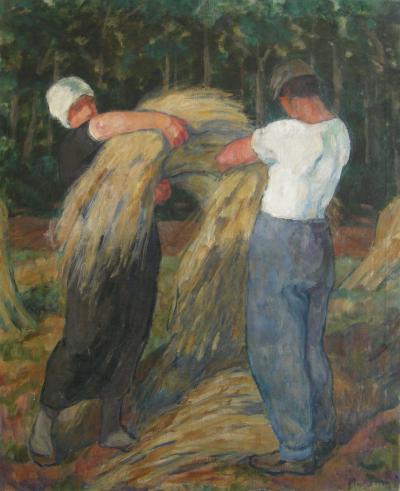
Max Stern was born to Jewish parents, but his father died before his birth and his mother, Rosalie Stern née Rothschild, died in 1883. Together with his three older siblings Leopold, Louise and Ida he came to his mother's sister, Victorine star field. Best business location in Düsseldorf she led a fabric store for silk goods, clothing and decorations, where the Rhenish nobility and the upper middle class was for dresses. At age 16, Max Stern was included in the elementary class at the Düsseldorf Academy and then attended classes given by Eduard von Gebhardt, of the specialist biblical history painting taught. Stern later moved to the Munich Academy of Fine Arts to the American genre and portrait painter Carl von Marr. Probably not entirely voluntarily, he returned back to Dusseldorf in 1894, to his military service as a one year volunteer abzuleisten. On the last day of military service, he traveled by night train to Italy and spent several months in Venice to study art in the lagoon city and paint on itself. Like all painters, whose work on time in the artistic upheaval at the turn of the 19th the 20th Century fell, Max Stern had also conquer his position in the modern art world. As a figure painter, he began freed quickly from the influence of his former teacher and was receptive to avant-garde trends. 1893 could star as the youngest participant in the newly founded Munich Secession exhibit a painting, it was followed by exhibitions in 1897 at the Seventh International Art Exhibition in the Crystal Palace in Munich, 1906, etc., on the Great Art Exhibition in Berlin and Dusseldorf 1932 Max Stern wrote in retrospect about his artistic beginnings: "... then, in the prime of Pleinairism and realism, I was drunk with youth and enthusiasm ', as Zola once wrote, painted fanatic of these directions, and drew just outside in free and the holiday used to staying in Knokke see M. (Belgian seaside resort), where met the younger artists from around the world. There were exciting times. "(Düsseldorf City Gazette, June 15, 1932) First of the Hague School thrilled and naturalism, he acquired after 1900, the painting of the French Impressionists. The powerful brush strokes and the sensual, detached use of color were now dominant. Throughout his life he was concerned with the representation of the people in rural and urban backgrounds. Garden strollers on the promenade, convivial chats in the restaurant or picnic interested him as the privation of life of herring fishing in the North Sea and in general everyday subjects of humble life beyond allegory and pathos. A recurring theme is the picture working man: Kuhhirtinnen, laundresses, Provencal peasants in the fields, fruit pickers, Workers tarring in Dusseldorf or priest in the celebration of a procession. For the wealthy bourgeoisie from the Rhineland painted Stern social events in public places, group pictures and individual portraits, the style and the color of the painting by Renoir and Edouard Manet. Locations in Düsseldorf courtyard garden with its legendary, destroyed in 1943 at the Coffee Garden Ananasberg. Representations of places, lively street cafes, flower beds and paths, which are found in all major cities, could outgrow star over Dusseldorf. His pictorial subjects corresponded to contemporary taste and reflect the self-image of the upper class, dressed in the latest fashion at the Sunday walk, outdoor picnic, or visit Café represented as strollers on the boulevard is. This group is characterized by the use of bold primary colors from. Because of its proximity to the French art fascinated him since 1910, the art dealer Alfred Flechtheim from Münster, for his flair for the avant-garde movements was famous for Max Stern. During the First World War was four star sergeant in the air defense in France and Belgium, but could still feed with impressionist paintings the major art exhibitions in Berlin and Dusseldorf. After the colorful impressionism is in the over 50-year-old Max Stern in the late 1920s, a turn to the New Objectivity seen. The color palette is dominated now gray-green hues. Socially critical images pervade Max Stern entire oeuvre. His interest in the concerns of the disadvantaged is no attitude , it is the result of an attentive, compassionate observer. Max Stern succeeded despite an official prohibition in 1933 and the exclusion from the Düsseldorf artist association Malkasten until 1936 to take part in exhibitions in Berlin and Dusseldorf. "Artists are under" called the Art Association of the Rhineland a show with works that had given each other artists. 1935 showed the Jewish Cultural Association Dusseldorf works by Jewish artists and the following spring was Max Stern painting "dockers" and "Landscape in Provence" in Berlin to see the Empire Exhibition of Jewish artists. The establishment of the " Reich Chamber of Culture of Fine Arts "had led to unpopular and non-Aryan artists ones on the outside, because only those who applied for the purposes of the new cultural ideology as" reliable "and compliant was accepted as a member, and could even appropriate the property Painting materials arrive. Propaganda Minister Joseph Goebbels organized the 1937 seizure of so-called "degenerate art" and asked to see some of the works of art in an eponymous traveling exhibition. As " degenerate art "in the Nazi regime were all works of art and cultural currents that were not with the appreciation of art and beauty ideal of the National Socialists in line. The works covered by the Max Stern verdict . On 26 August 1937, a charcoal drawing titled "Resting pilgrims" from the Municipal Art Collection Dusseldorf has been removed. But not only as an artist Max Stern public condemnation was suspended, and his marriage to Alice Helene was Burnier (1877-1943) put to a severe test. Back in September 1935 were the Nuremberg Laws so-called " mixed marriages "as" miscegenation ". Many spouses were encouraged under penalty of divorce, made some spouses before the Düsseldorf district court even the process. While from both the high social prestige of Brunier and star, and the four-year participation of the painter have obtained the First World War a reprieve for his prosecution, but the artist was after Kristallnacht hardly immune. The star couple lived with the aged mother in recent years in very poor circumstances. On 9 November 1938 stormed the SA and their house destroyed pictures and furnishings. The painting offered no livelihood anymore because even the possession of a "Jewish images" was considered a misdemeanor. His final years were spent siblings star with the constant fear of being discovered and deported. Rather, they found protection in the hospital in which the loss of his brother Leopold until approval was working as a doctor. Mercy nuns hid the two brothers when the Gestapo again harassed Jewish citizens, and like cattle drive through the streets. The deportations were both narrowly escaped. Max Stern died in a cellar at the " Pentecost attack "in 1943 in Dusseldorf. He had been forbidden as Jews to take refuge in a bomb shelter. In 2009, in the garden street in Dusseldorf, Pempelfort a stumbling block set a reminder for brand Max Stern. His artistic legacy is mainly privately owned in the Rhineland, in Israel and the U.S.. The international art trade and auction his paintings are traded for years at competitive prices. The Museum Kunst Palast , Dusseldorf City Museum and the paintbox some of his paintings, drawings and cartoons are held in the magazines. Source: Translated from Wikipedia
Works
|