
John James Audubon (Bien Edition)
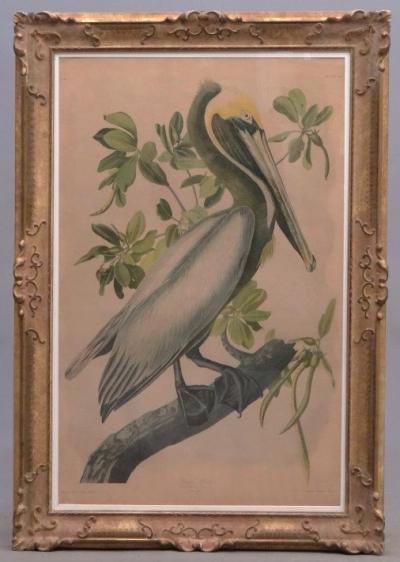
Bien Edition Chromolithographs The Bien edition prints of the Birds of America, just like the Havell editions, were produced by the Audubon family, and thus are originals. Unlike the Havell edition prints which were produced in England, the Bien Edition prints were produced completely in America. Thus, they are truly American originals. In 1858, about seven years after John James Audubon passed away, his younger son John Woodhouse Audubon initiated an ambitious project to reissue the Birds of America to solve some of the mounting financial problems. He recruited the Roe Lockwood Company in New York city to publish the works and Julius Bien for lithography. Unlike the Havells which were produced from copper engraving plates, Julius Bien utilized the newly emerging chromolithography process as a way of reducing the costs of production. Chromolithography utilized different sets of printing stones to produce a given plate, some with different colors to produce the final colored image. The use of different stones occasionally resulted in very slight misregister of colors on the dark outlines of birds and background, thus serving as a charming reminder of chromolithography process. Larger images were printed on a single page as in the Havell edition, whereas smaller images were printed two per page. All the larger images as well as some smaller images carry the credit "Chromolithy by J. Bien, New York, 1860". Thus these images are commonly referred to as the Bien edition plates. Unfortunately, the start of the Civil War in 1860 brought an abrupt end to this project (and a financial ruin to the Audubon family) after only about 105 pages were printed. It was said that about 100 copies of each page (with bird images) were produced, but most of them did not survive.
John James Audubon (American 1785-1851) John James Audubon was not the first individual to attempt to paint and describe all the birds of America (Alexander Wilson has that distinction), but for half a century he was the young country's dominant wildlife artist. His seminal Birds of America, a collection of 435 life-size prints, quickly eclipsed Wilson's work and is still a standard against which 20th and 21st century bird artists, such as Roger Tory Peterson and David Sibley, are measured. Although Audubon had no role in the organization that bears his name, there is a connection: George Bird Grinnell, one of the founders of the early Audubon Society in the late 1800s, was tutored by Lucy Audubon, John James's widow. Knowing Audubon's reputation, Grinnell chose his name as the inspiration for the organization's earliest work to protect birds and their habitats. Today, the name Audubon remains synonymous with birds and bird conservation the world over. Audubon was born in Saint Domingue (now Haiti), the illegitimate son of a French sea captain and plantation owner and his French mistress. Early on, he was raised by his stepmother, Mrs. Audubon, in Nantes, France, and took a lively interest in birds, nature, drawing, and music. In 1803, at the age of 18, he was sent to America, in part to escape conscription into the Emperor Napoleon's army. He lived on the family-owned estate at Mill Grove, near Philadelphia, where he hunted, studied and drew birds, and met his wife, Lucy Bakewell. While there, he conducted the first known bird-banding experiment in North America, tying strings around the legs of Eastern Phoebes; he learned that the birds returned to the very same nesting sites each year. Audubon spent more than a decade in business, eventually traveling down the Ohio River to western Kentucky - then the frontier - and setting up a dry-goods store in Henderson. He continued to draw birds as a hobby, amassing an impressive portfolio. While in Kentucky, Lucy gave birth to two sons, Victor Gifford and John Woodhouse, as well as a daughter who died in infancy. Audubon was quite successful in business for a while, but hard times hit, and in 1819 he was briefly jailed for bankruptcy. With no other prospects, Audubon set off on his epic quest to depict America's avifauna, with nothing but his gun, artist's materials, and a young assistant. Floating down the Mississippi, he lived a rugged hand-to-mouth existence in the South while Lucy earned money as a tutor to wealthy plantation families. In 1826 he sailed with his partly finished collection to England. "The American Woodsman" was literally an overnight success. His life-size, highly dramatic bird portraits, along with his embellished descriptions of wilderness life, hit just the right note at the height of the Continent's Romantic era. Audubon found a printer for the Birds of America, first in Edinburgh, then London, and later collaborated with the Scottish ornithologist William MacGillivray on the Ornithological Biographies - life histories of each of the species in the work. The last print was issued in 1838, by which time Audubon had achieved fame and a modest degree of comfort, traveled this country several more times in search of birds, and settled in New York City. He made one more trip out West in 1843, the basis for his final work of mammals, the Viviparous Quadrupeds of North America, which was largely completed by his sons and the text of which was written by his long-time friend, the Lutheran pastor John Bachman (whose daughters married Audubon's sons). Audubon spent his last years in senility and died at age 65. He is buried in the Trinity Cemetery at 155th Street and Broadway in New York City. Audubon's story is one of triumph over adversity; his accomplishment is destined for the ages. He encapsulates the spirit of young America, when the wilderness was limitless and beguiling. He was a person of legendary strength and endurance as well as a keen observer of birds and nature. Like his peers, he was an avid hunter, and he also had a deep appreciation and concern for conservation; in his later writings he sounded the alarm about destruction of birds and habitats. It is fitting that today we carry his name and legacy into the future.
Works
|